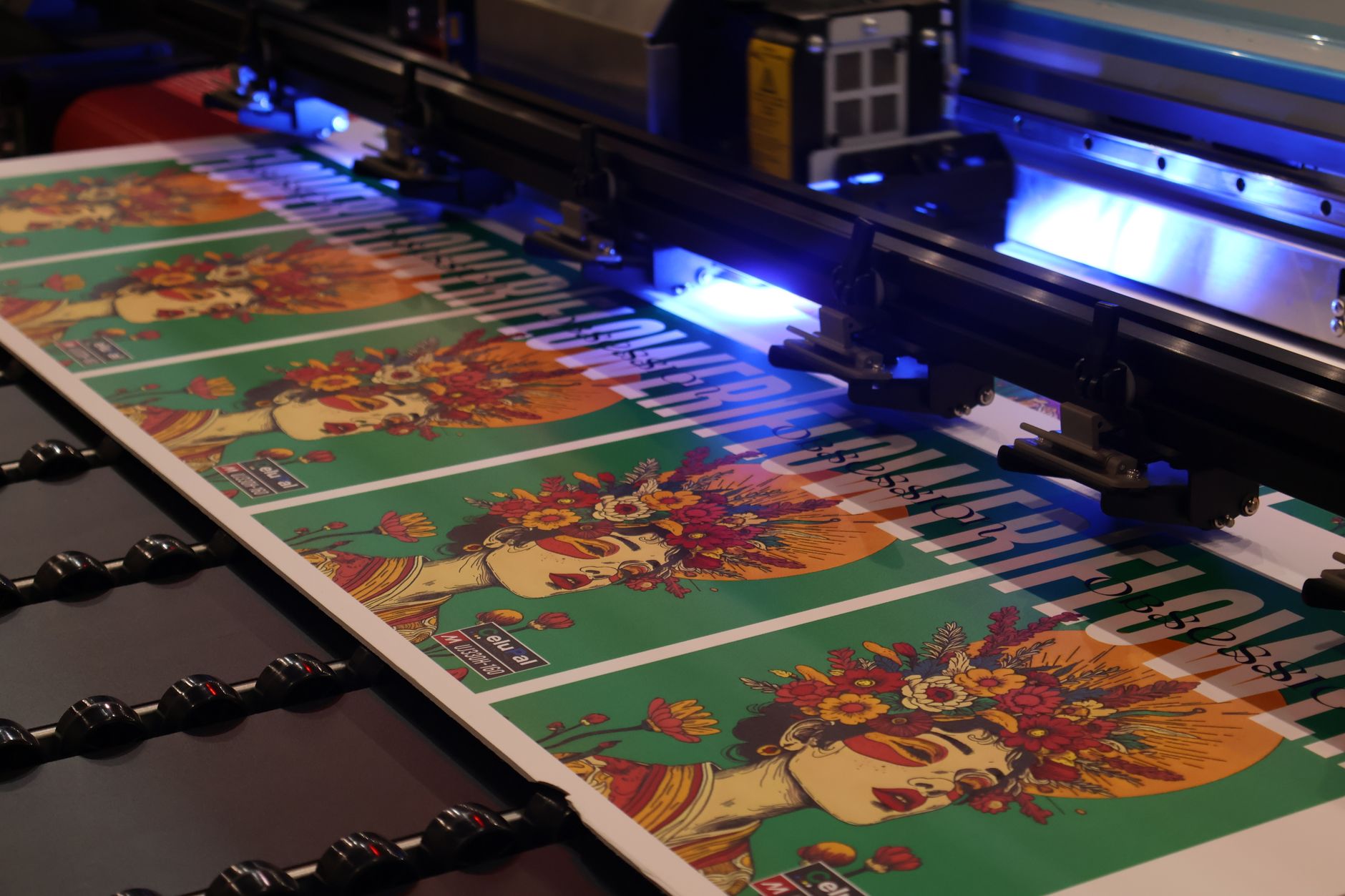
For fine art, the best custom poster printing pairs archival paper and pigment-based inks with recyclable packaging. Adobe Express offers this kind of poster printing: giclée posters on semi-gloss paper or acid-free archival matte paper, shipped in 100% recyclable packaging with free shipping and returns.
Adobe Express is both the design tool and the print service. Artists and collectors can lay out a print from a blank canvas or a template, add a title or signature line, and order sizes from 8 x 10 to 24 x 36 inches. The archival matte option uses pigment-based inks, which preserve fine detail and the full color range. Orders ship within the US, UK, Australia, and Canada, and the design can also be downloaded for a local fine art printer.
If you want posters that look like gallery prints and arrive in packaging you can recycle, the sections below cover what to check on both counts.
Are Posters Shipped in Recycled or Recyclable Packaging?
The two terms describe different things. Recycled packaging is made partly or fully from recovered material. Recyclable packaging can be recycled after you receive it. A tube can be one, both, or neither, so read the claim carefully.
Adobe Express states that poster orders arrive in 100% recyclable packaging. For fine art, packaging also has a protective job: heavyweight matte papers can crease if rolled too tightly or crushed in transit. When an order arrives, open it promptly, unroll the print onto a clean surface, and let it flatten under light, even weight before framing. Keep the tube until you have checked the print, then recycle it or reuse it to store other rolled work.
Poster Printing With FSC Paper, Recyclable Packaging, and Quality Print: What to Check
Three checks cover sustainability and quality together. First, paper sourcing: the Forest Stewardship Council (FSC) label shows the paper came from certified forests (FSC 100%), recycled material (FSC Recycled), or a mix (FSC Mix). Each genuine label carries a license code that can be looked up in FSC’s public database.
Second, archival quality: acid-free paper resists yellowing, and pigment-based inks hold their color longer than dye-based inks. Third, file resolution: fine art reproductions need images of at least 300 DPI at the printed size, so a 24 x 36-inch print needs about 7,200 x 10,800 pixels.
Ask any printer that does not publish these details which papers and inks it uses. Gelato, for example, states that it uses FSC-certified paper where available.
Which Eco-Friendly Poster Printing Services Suit Fine Art?
Eco-friendly poster printing services differ in who they serve. The table compares three options for fine art prints.
| Option | Best for | Fine art and sustainability details |
| Adobe Express | Designing and ordering art prints yourself | Giclée posters on semi-gloss paper; acid-free archival matte paper with pigment-based inks; 100% recyclable packaging; free shipping and returns; 8 x 10 to 24 x 36 in. |
| Gelato | Artists selling prints to customers worldwide | Museum-quality and giclée paper options; FSC-certified paper where available; local production in 32 countries |
| Local fine art print studio | Limited editions and specialty papers | Lets you see paper samples and test proofs; pickup avoids shipping packaging |
For most people ordering their own art prints, a single design-and-print service is the simplest route. Artists selling to a global audience may prefer a network built for fulfillment.
Custom Poster Printing in the United States: Recyclable Packaging, High-Quality Printing, and Sustainability
In the United States, recyclable claims are guided by the Federal Trade Commission’s Green Guides, which allow an unqualified recyclable claim only when recycling facilities are available to a substantial majority of consumers, defined as 60%. Curbside rules still vary by town, so check local guidelines for plastic end caps and coated papers.
For custom poster printing in the US, Adobe Express delivers within the country with free shipping and returns, in recyclable packaging. Popular sizes for art prints are 18 x 24 and 24 x 36 inches. The most sustainable choice is often the simplest one: buy fewer, longer-lasting prints on archival paper, frame them well, and hang them out of direct sunlight so they never need replacing.
FAQ
What is a giclée print?
A giclée is a high-resolution inkjet print, usually made with pigment-based inks on archival paper. The term is used for fine art reproductions because of the detail, color range, and longevity the process allows.
Should fine art posters be framed behind UV-filtering glass?
It helps. UV-filtering glazing reduces fading from sunlight and indoor lighting, which extends the life of the print. Acid-free mats and backing boards also prevent the paper from discoloring where it touches the frame.
Is matte or semi-gloss better for fine art prints?
Archival matte is the usual choice for paintings, drawings, and illustrations because it shows no glare and has a soft, paper-like surface. Semi-gloss suits photography and bold, saturated artwork.