
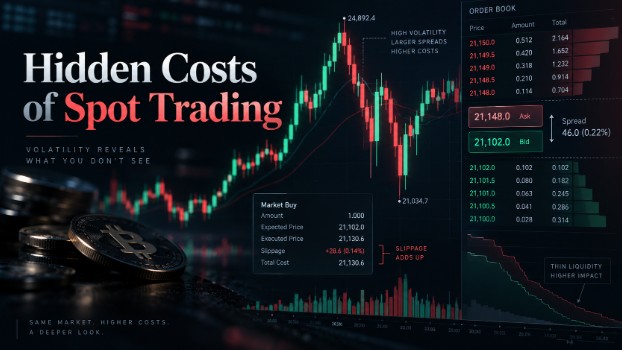
A 0.1% trading fee is only part of the real cost of a spot trade. In volatile markets, wider spreads and thinner liquidity can increase slippage, so one-way execution cost is better estimated as trading fee + half-spread + price impact, measured against the mid-price when the trade is initiated.
If slippage is already measured from the mid-price, it includes the half-spread and should not be counted twice.
Quick Answer
Spot trading avoids the liquidation and funding-rate risks of leveraged derivatives. During volatility, however, its effective cost can rise sharply because spreads widen and order-book depth thins.
Why Does Spot Trading Become More Expensive During High Volatility?
Liquidity Can Disappear Faster Than Trading Volume Suggests
Three measures often get blurred together:
- Trading volume is how much has already traded.
- Market depth is how much can be bought or sold right now near the mid-price.
- Spread is the distance between the best bid and best ask.
High 24-hour volume does not guarantee low slippage on your order. Liquidity is better assessed by combining spreads, market depth, and expected slippage rather than relying on trading volume alone.
Market depth is particularly useful because it shows how much liquidity is currently available around the market price. During volatile periods, that liquidity can change quickly even when reported trading volume remains high.
Why Event-Driven Markets Are Different
Volatility often follows central-bank decisions, CPI or employment releases, ETF-related flows, security incidents, token listings and unlocks, and sudden crypto-specific news.
A common pattern follows: volatility rises, market makers widen or pull quotes, depth thins, and spreads and slippage increase. Liquidity does not react equally across trading pairs, so less-liquid markets can experience substantially larger execution costs.
Even major BTC pairs can see slippage rise sharply during market shocks as available liquidity disappears from the order book.
What Are the Hidden Costs of a Spot Crypto Trade?
The costs fall into two groups. Direct execution costs reduce the value of every fill, while execution risks and trading frictions may or may not create an additional cost depending on subsequent market movements.
Direct execution costs
| Cost | What Causes It | Calm Market | High-Volatility Market | What to Check |
| Trading fee | Maker/taker fee schedule | Predictable | Predictable | Your fee tier and order type |
| Half-spread | Crossing from mid to the best bid/ask | Often small on liquid pairs | Can widen rapidly | Best bid vs best ask |
| Price impact | Your order walking through multiple order-book levels | Low for small orders | Higher as depth thins | Depth relative to order size |
Price impact is the main reason a large market order slips. A small order that fits entirely inside the best quote may pay only the half-spread, although the quote can still move before execution.
Execution risks and trading frictions
| Risk | What It Means | Most Relevant For |
| Partial-fill / opportunity risk | Only part of a limit order fills and the price moves away from the rest | Limit and post-only orders |
| Adverse selection | Your order fills just before the market moves against you | Resting maker orders |
| Quote-asset risk | The quote asset temporarily trades away from its expected value | Traders using stablecoin or fiat pairs |
None of these is a fixed charge. A partial fill costs nothing directly, but the remaining position may need to be completed later at a worse price.
Adverse selection matters most for passive orders. For example, a resting limit buy may fill while aggressive selling is pushing through that price, after which the market could continue lower.
Quote-asset risk is better viewed as basis and counterparty exposure than an execution cost, but it can become more relevant during periods of market stress.
Market Order vs Limit Order During Volatility: Which Costs More?
Market Orders: Certainty of Execution, Uncertainty of Price
A market order prioritizes immediate execution. In exchange, the trader typically pays the taker fee, crosses the spread, and absorbs any price impact created by the order size.
The larger the order relative to available depth, the further the average execution price can move from the mid-price.
Limit and Post-Only Orders: Price Control, No Fill Guarantee
A limit order sets the maximum price you are willing to pay when buying or the minimum price you will accept when selling.
However, a limit order does not automatically receive maker pricing. If its price crosses the opposite side of the order book, it can execute immediately as a taker order.
A post-only instruction prevents this by allowing the order to enter the order book only if it adds liquidity. If it would execute immediately, the platform cancels or rejects it instead.
This gives traders greater price and fee control, but the trade-off is execution uncertainty: the market may move away before the order fills.
Stop-Market Orders: The Stop Price Is a Trigger, Not a Fill Price
A stop-market order becomes a market order once its trigger price is reached.
This means the stop price does not guarantee the final execution price. During a fast move or price gap, the actual fill may occur significantly beyond the trigger.
A stop-limit order provides more control over the acceptable execution price, but introduces the opposite risk: the order may not fill at all.
Scenario Analysis: How a 0.1% Trading Fee Can Become a Much Larger Cost
The example below uses a $10,000 spot market buy. Every figure is hypothetical and does not represent current BTC, altcoin, or exchange conditions.
| Scenario | Fee | Half-Spread | Price Impact Beyond Best Ask | Total Cost vs Mid |
| Deep book, normal conditions | 0.10% | 0.02% | 0.03% | ~0.15% / $15 |
| Major volatility event | 0.10% | 0.20% | 0.50% | ~0.80% / $80 |
| Thin altcoin order book | 0.10% | 0.60% | 2.00% | ~2.70% / $270 |
The half-spread column represents the distance from the mid-price to the best ask. The implied full bid-ask spreads in these examples are 0.04%, 0.40%, and 1.20%.
The fee remains 0.10% in every scenario, yet the total execution cost varies sharply.
Order size changes the result as well. On the same pair, a $500 order might fill entirely near the best ask, while a $50,000 order could consume several levels of liquidity.
How to Estimate the True Cost Before Placing a Spot Trade
Before submitting an order on a major market such as Spot Trading: BTC/USDT, open the order book and check five things:
- Bid-ask spread in basis points. Compare the current spread with its normal range. Half of the spread is approximately the minimum crossing cost from the mid-price.
- Order-book depth. Check how much liquidity is available within roughly 0.1%, 0.5%, and 1% of the mid-price.
- Order size relative to depth. If your order is large compared with the first few price levels, expect greater price impact.
- Maker or taker fee. Confirm which fee applies to your intended execution method.
- Expected average fill vs mid. Estimate the average execution price from the visible order book. The difference from the mid-price reflects the spread and price impact, so add the trading fee separately.
How Can Traders Reduce Spot Trading Costs During Volatility?
| Situation | Possible Approach | What You Give Up |
| Deep book + urgent trade | Market/taker execution | Some cost in exchange for execution certainty |
| Wide spread + low urgency | Limit or post-only order | Execution certainty |
| Large order | Split or schedule the order | Timing and information-leakage risk |
| Sudden event volatility | Wait for the order book to stabilize | Risk of missing the move |
| Thin altcoin market | Reduce size or skip the trade | The opportunity itself |
| Multiple available pairs | Compare liquidity across suitable pairs | Operational simplicity |
Splitting a large order can reduce the price impact of each individual fill, but it leaves the remaining size exposed for longer.
During a fast directional move, the market may move away between executions. Repeated visible orders can also reveal trading intent.
Larger traders may use TWAP or VWAP schedules, iceberg orders, or other execution techniques to balance market impact against timing risk. These tools manage the trade-off rather than eliminating execution costs.
When Is Paying Higher Spot Execution Cost Reasonable?
The cheapest execution is not always the most practical one. The important question is whether execution urgency justifies the additional cost.
Accepting a higher immediate cost may be reasonable when you need to reduce unwanted exposure quickly, when liquidity remains deep enough to contain price impact, or when securing execution matters more than saving a few basis points.
Waiting may be more appropriate when the spread is unusually wide, your order is large relative to visible depth, the trade is discretionary, or a temporary market shock has drained liquidity.
The objective is therefore to manage total execution quality, rather than focusing only on the advertised trading fee.
FAQs About Spot Trading Costs During Volatility
Does spot trading have slippage?
Yes. Any order that takes liquidity can execute away from the mid-price because of the half-spread, price impact, or both.
Are market orders more expensive than limit orders?
Often, but not always. Market orders normally cross the spread and use taker execution. A limit order can also become a taker order if it crosses the book, while a post-only order can reduce execution costs but may never fill.
Does high trading volume mean low slippage?
Not necessarily. For an individual trade, available order-book depth at the time of execution can matter more than aggregate 24-hour trading volume.
Can BTC/USDT experience significant slippage?
Yes. Major trading pairs are generally deeper than smaller markets, but their spreads and available depth can still deteriorate quickly during major market shocks.
What matters more: fees or slippage?
It depends on market conditions and order size. In calm, liquid markets, the trading fee may be the largest cost component. During volatility or in thin order books, the half-spread and price impact can become much larger.